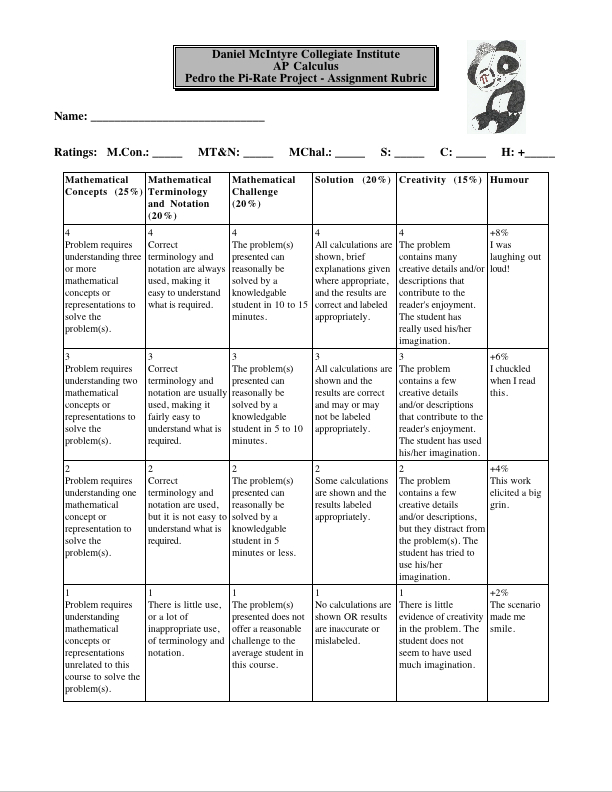
These are the criteria by which your work will be assessed. Please share your thoughts regarding if and how we should change this rubric in the comments below this post. This instrument can be made better only if you participate in its development -- it's your mark on the line; it's up to you ...
Creativity (25%)4
The problem contains many creative details and/or descriptions that contribute to the reader's enjoyment. The student has really used his/her imagination.
3
The problem contains a few creative details and/or descriptions that contribute to the reader's enjoyment. The student has used his/her imagination.
2
The problem contains a few creative details and/or descriptions, but they distract from the problem(s). The student has tried to use his/her imagination.
1
There is little evidence of creativity in the problem. The student does not seem to have used much imagination.
Mathematical Concepts (30%)4
Problem requires understanding three or more mathematical concepts or representations to solve the problem(s).
3
Problem requires understanding two mathematical concepts or representations to solve the problem(s).
2
Problem requires understanding one mathematical concept or representation to solve the problem(s).
1
Problem requires understanding mathematical concepts or representations unrelated to this course to solve the problem(s).
Mathematical Terminology and Notation (20%)4
Correct terminology and notation are always used, making it easy to understand what is required.
3
Correct terminology and notation are usually used, making it fairly easy to understand what is required.
2
Correct terminology and notation are used, but it is not easy to understand what is required.
1
There is little use, or a lot of inappropriate use, of terminology and notation.
Mathematical Challenge (25%)4
The problem(s) presented can reasonally be solved by a knowledgable student in 10 to 15 minutes.
3
The problem(s) presented can reasonally be solved by a knowledgable student in 5 to 10 minutes.
2
The problem(s) presented can reasonally be solved by a knowledgable student in 5 minutes or less.
1
The problem(s) presented does not offer a reasonable challenge to the average student in this course.
Solution (20%)4
All calculations are shown, brief explanations given where appropriate, and the results are correct and labeled appropriately.
3
All calculations are shown and the results are correct and may or may not be labeled appropriately.
2
Some calculations are shown and the results labeled appropriately.
1
No calculations are shown OR results are inaccurate or mislabeled.
Bonus Marks! - Humour or Drama+0%
No humour or drama used in the problem presentation.
+2%
The scenario made me smile.
+4%
This work elicited a big grin/a sense of suspence.
+6%
I chuckled/was very moved when I read this.
+8%
I was laughing/crying out loud!